

Staying the course: 11 initial thoughts after reading Motown and the Making of Working-Class Revolutionaries
The self-told story of the League of Revolutionary Black Workers

by Nat Winn
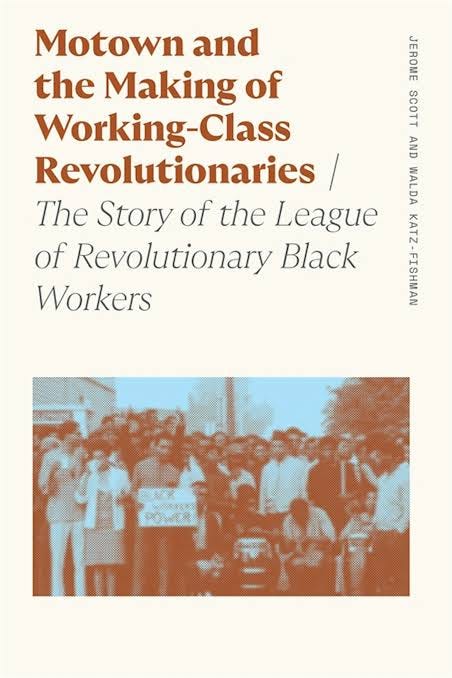
I recently had the chance to read Motown and the Making of Working-Class Revolutionaries: The Story of the League of Revolutionary Black Workers, narrated by Jerome Scott and Walda Katz-Fishman. It is the story of the League of Revolutionary Black Workers and the work many of them carried on after that organization ended, told by the actual participants themselves. It is the story of perseverance and staying the revolutionary course. The following are 11 thoughts I wrote down after reading the book.
The convergence between the ideas of Nelson Peery and the Build and Fight formula. A future of human disposability, mass unemployment, automation, AI, digital.
Jerome Scott talks about the need to focus on theory and political education in a time of revolutionary ebb.
Seems like there was a deeply uneven process of political education and lack of democracy in the organizational structure of League of Revolutionary Black Workers (LRBW), and yet there were many practical successes.
Once the leadership broke from the LRBW and the rank and file linked up with California Communist League, in the book, it seems that any mention of practice comes to a halt, and the sole focus seems to be political education.
What were the political practices other than collective study of CLP and the League of Revolutionaries for a New America (LRNA)?
The combination of the more theory-oriented California Communist League (CCL) lacking a base, connecting with the LRBW cadre that had done a lot of practical work and had much success in their practical work made for a good collaboration. It says a lot that the LRBW actually went and sought that political education out.
One gets a sense from the book and the interviews that there is a real good social chemistry among the LRNA folks and they genuinely appreciated each other.
Question of winning reforms and integration in the UAW and the workplace and what comes next. There was a lot of talk about political education in the second half of the book. I would like to get a better sense of LRBW vision and also Black Workers Congress (BWC) and CLP vision of strategy. For LRBW, in particular, how did the gains in the factory and the union relate to the goal of revolutionary victory?
It was good to see Mike Tomlin who was on the other side of the split interviewed in this book. Also, Mike T’s observation about infiltration seems supported by the work of Aaron Leonard regarding when the BWC was part of a party building liaison committee with the Revolutionary Union and the Puerto Rican Revolutionary Workers Committee (PRRWC) in 1975 that seems to have been sabotaged based on Leonard’s research of a Freedom of Information Act (FOIA) request and the book he wrote called Heavy Radicals.
The analysis developed by Peery with CLP and LRNA seems to clearly be manifested currently and is a contribution of the collective study of the formation to world revolution. Respect and gratitude.
The Build and Fight formula seems to continue to be, in my thinking, a solid practical course of action based on the analysis of Peery and others.