

Organizing around social evolutionary patterns
Emerging cultural trends and Cooperation Jackson's Build and Fight formula

by Nat Winn
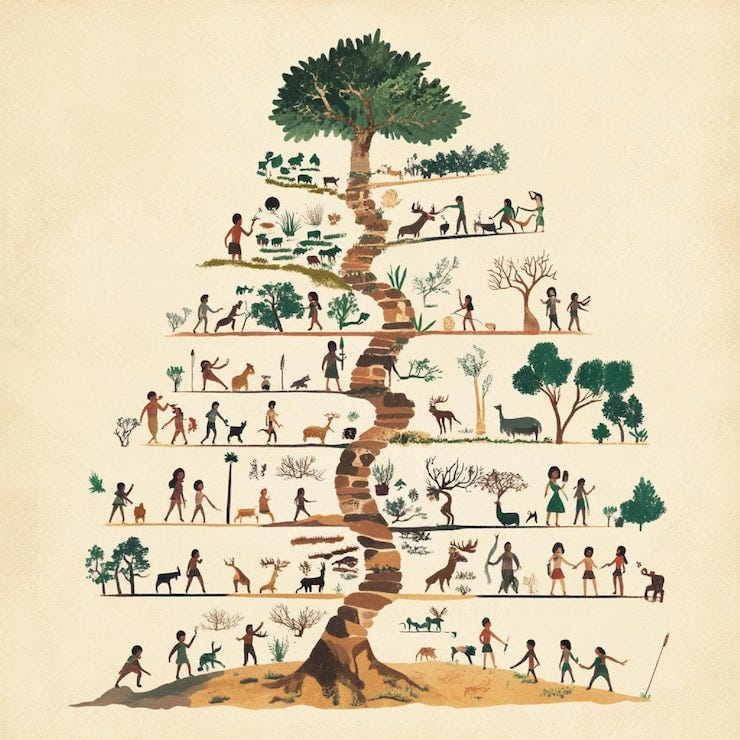
Reading Murray Bookchin’s philosophical essays on dialectical naturalism, I came across a description of social convergent evolution. Particularly Bookchin wrote about patterns of cooperative behavior as part of the way in which different species or disparate groups of humans survived and thrived.
For instance, in three distinct areas of the planet - in China, the West Asian Mediterranean, and Mesoamerica; humans developed similar agriculturally based societies based on three distinct staples (rice, grain, and maize). Similar pastoral ways of living also developed in the Eurasian steppe and in East Africa. In both examples these societies had little to no contact with each other but developed similar patterns or ways of survival.
Bookchin breaks these cooperative patterns down in other animal species and living things down to the way that cells must work cooperatively to form living organisms.
While Bookchin asserts that these patterns may actually be less aleatory and I tend to lean toward the idea that there is much more contingency in the world than western cosmological apriorism's allow for, still, Bookchin’s analysis leaves me with a lot to think about.
Contemporary patterns
A comrade recently pointed out to me that in thinking of this idea of social convergent theory (my understanding is that when applied to human societies this would be called “cultural convergent evolution.), more recent examples of the emergence of the Arab Spring and Square movements in the 2010s would apply.
It is also the case that from Ireland and Scotland to the United States to Sudan, mutual aid and forms of cooperative economy such as community wealth building are emerging and growing in popularity. I’ve come to understand that these recent cooperative patterns in human survival strategies in order to respond to climate disaster, rising fascism, rising food costs and malnutrition, rising housing costs, and wars; are patterns that inform Cooperation Jackson’s Build and Fight formula when it comes to suggestions and arguments about the types of organizing that are needed for the current historical conjuncture and the way events and crisis are tending.
How patterns inform organizing
Those who are familiar with the Build and Fight formula know that mutual aid, worker and consumer owned cooperatives, food sovereignty, and decommodification of housing are key features in a war of maneuver in order to develop self-sufficiency and dual power to challenge capitalism as a way of human social relations and economy.
The patterns suggested above mean that millions of people have already started these types of projects and that these projects can potentially be coordinated politically into a direct challenge, a war of position in the Gramscian sense against the capitalist system itself. In other words, our organizing as revolutionaries can itself be modeled around tendencies and forms of resistance and survival that are already existing in society.
This time around
So, in this sense there are cultural evolutionary patterns that are already emerging in different parts of the world. Organizers can build around these patterns and because of things like modern technology and dramatically enhanced global communication capabilities on a global level, such patterns can be intentionally coordinated and organized to challenge capitalism and develop more cooperative societies.
This time around, in other words, our societies can communicate with one another and the societies we create on a global level can be much more in contact and inspire innovation and creative capacity in each other to develop a more cooperative society. Perhaps one can say that the patterns that emerged through cultural evolution can be traced to the causality of capitalist social relations and crisis and have created an opportunity for revolutionary agency and those wanting to build towards an egalitarian world.
The Build and Fight formula then is a modern argument for “what is to be done” a practical call to action that can be implemented by all types of revolutionaries and through which we can develop methods for summation as this strategy is implemented and develops, creating alliances of different social groups and varying types of ruling class and reactionary opposition as well.
Great piece. Since you are reading Bookchin on dialectical naturalism, you might find it rewarding to contrast him with Jared Diamond’s "Guns, Germs, and Steel."
Diamond brilliantly debunks racist myths of European superiority, proving human potential is equal everywhere.
Having said that, his framework has a massive blind spot: It completely erases class struggle and human agency, reducing global inequality to geographic accidents.
Diamond falls into a flat, mechanical determinism based on mere geography. He completely glosses over internal class conflicts, the exploitation of labor, and the conscious, violent decisions by ruling classes to expand.